

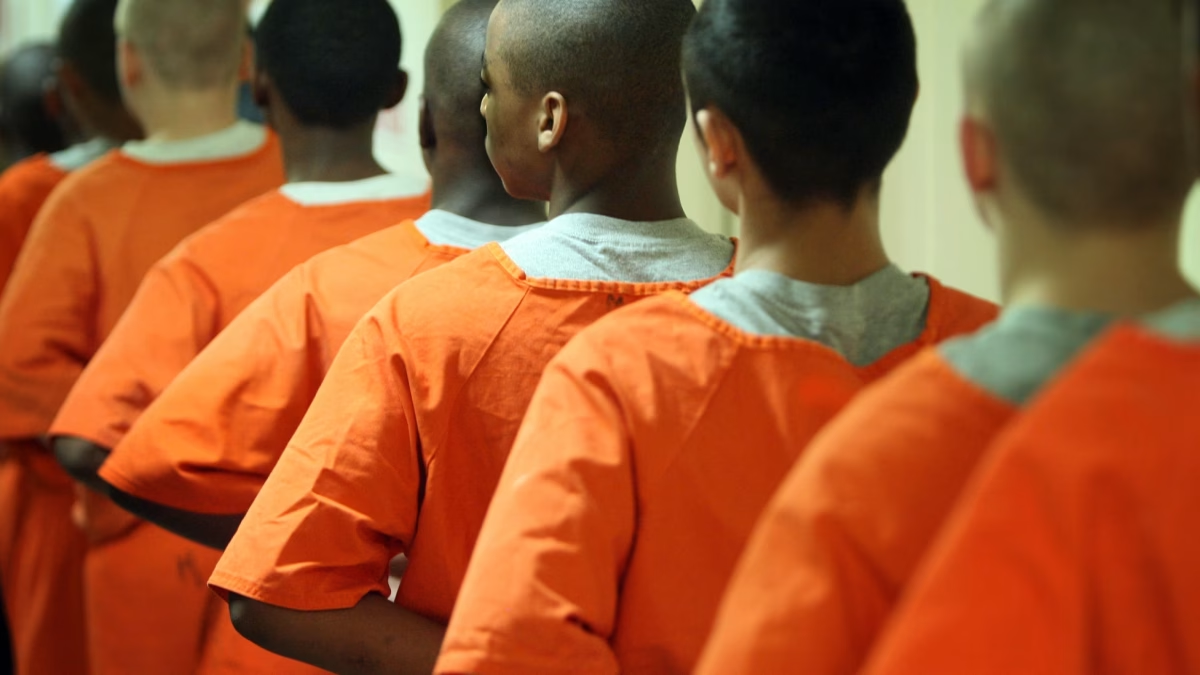
- Brings back group homes for youth who can’t stay in foster or community settings.
- Requires detention for teens who use guns or quickly reoffend.
- Allows longer detention stays and tougher penalties for some offenses.
- Shifts millions from community programs to fund more secure placements.
- Expands short-term crisis centers for youth in behavioral health emergencies.
Kansas lawmakers have voted to roll back key parts of the state’s 2016 juvenile justice reforms, overriding Gov. Laura Kelly’s veto to enact sweeping changes that shift the system back toward detention and facility-based care.
The original 2016 law — widely considered a landmark reform — aimed to reduce the number of young people in custody by focusing on rehabilitation, community-based services and keeping youth closer to their families. It limited how long juveniles could be held in detention, eliminated most state-run group homes and invested in programs such as mental health treatment and family therapy.
By many measures, the approach worked. The number of youth in state custody dropped significantly, and policymakers from both parties acknowledge the reforms helped move Kansas away from a system that relied heavily on incarceration.
But over time, lawmakers, foster care providers and others raised concerns that the system wasn’t equipped to handle a smaller group of high-risk youth — particularly those who cycle between foster care and the justice system or who exhibit more serious or violent behavior.
Even critics of the new law agree that gap exists.

Where the divide emerges is how to fix it.
Supporters of the new legislation argue it targets that specific group of youth who need more structured intervention. The law restores group homes — now referred to as residential facilities — as placement options, creating more beds for youth who cannot be safely managed in foster or community settings.
It also expands the use of juvenile stabilization centers, which provide short-term assessment, treatment and crisis intervention for youth experiencing behavioral health issues.
Another major change requires judges to detain certain youth regardless of standard risk assessments. Juveniles who used or possessed a firearm during an offense, as well as repeat offenders — defined as committing a second offense within three months — must now be held in detention.
The law also increases penalties tied to firearm-related offenses, extending possible detention from a previous range of six to 18 months up to 12 to 24 months. In addition, it doubles the maximum cumulative detention time for youth from 45 days to 90 days and broadens the types of cases that can result in detention.
To support these changes, lawmakers redirected roughly $4.5 million away from community-based programs — the cornerstone of the 2016 reforms — to fund additional facility space and services.
Republican lawmakers say these steps are necessary to address real-world failures in the current system. They point to reports of youth harming foster families, other children or service providers as evidence that some individuals require more secure environments and earlier intervention.
Democrats, however, argue the new law goes far beyond a targeted fix and instead undermines the core philosophy of the 2016 reforms.
They maintain that while a small subset of youth may need different placement options, expanding detention, increasing incarceration time and diverting funding from proven community programs risks reversing years of progress. Critics also warn that placing lower-risk youth in more restrictive settings could increase recidivism and lead to worse long-term outcomes.
At its core, the debate reflects a shared recognition of a problem — but a sharp disagreement over the solution.
We know the intentions of these lawmakers. They’re not making decisions based on what’s best for the juvenile system. They’re not actually looking at the future in a positive way for our young ones. They seek to make the juvenile system much like the prison system. They can make more money and spend less.
We know the truth.