

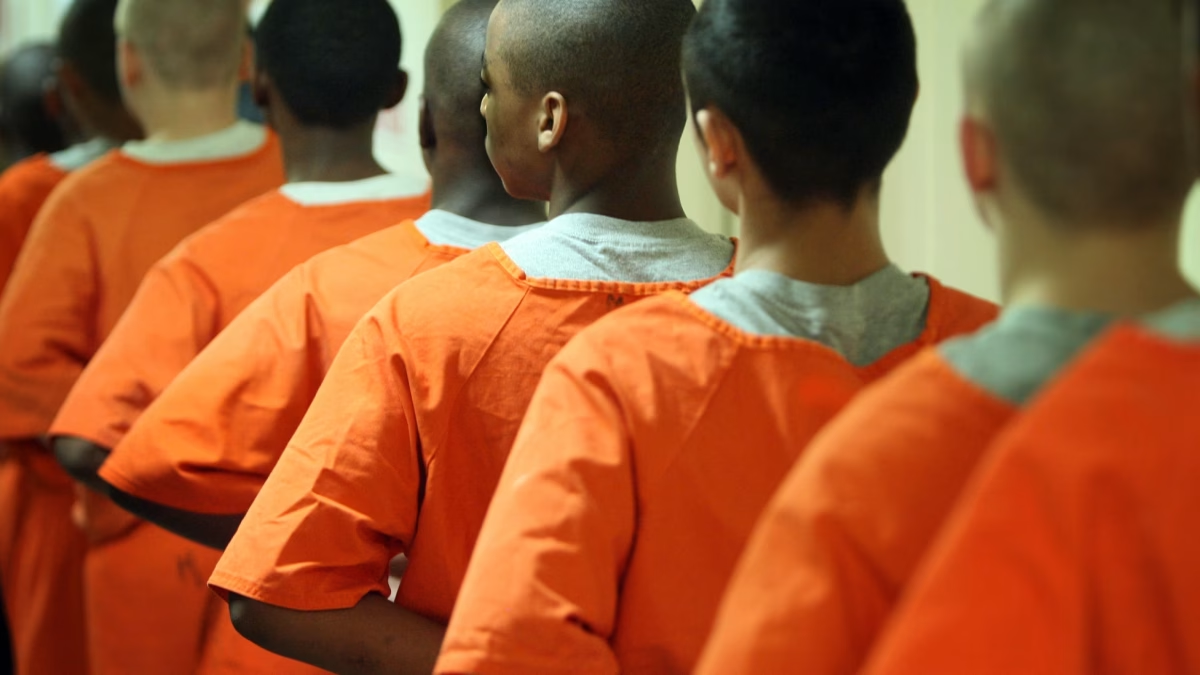
In 2016, Kansas leaders chose data over politics. They passed SB 367 to move our state away from the failed, expensive practice of “warehousing” children. It was a bipartisan victory rooted in a simple belief: Kansas families, not the government, are best equipped to raise our children.
Today, House Bill 2329 threatens to dismantle that legacy—and the tactics used to push it forward suggest that proponents of the bill are afraid of what happens when the public actually has a seat at the table.
A Process Designed to Silence Constituents
If a bill is good for Kansas, it should be able to withstand the light of day. Instead, HB 2329 has been ushered through a gauntlet of procedural hurdles designed to exhaust and exclude. After the House passed this bill in relative secrecy, the Senate took the exclusion a step further.
In a move that felt intentionally calculated, the Senate split the testimony. They forced those of us who traveled across the state to wait three days to be heard, knowing full well that a massive snowstorm was bearing down on the plains. For those who couldn’t make the trek, the “virtual” option was a dead end of broken links and technical barriers. This isn’t just a scheduling conflict; it is a deliberate attempt to ensure that the people most impacted by this legislation—youth and families—are silenced by geography and weather.
The “Two-Strike” Fast Track to a Cell
Perhaps the most dangerous part of this bill is a new amendment that creates a “two-strike” rule for children. Under HB 2329, if a young person has a second interaction with the juvenile intake system within a single year, the law mandates an automatic override of the state’s risk assessment tools.
Currently, intake workers use evidence-based tools to decide if a child is safe to go home with their family while awaiting trial. This bill replaces that professional judgment with a “fast track” to detention. We are telling Kansas youth: “If you stumble twice, we stop looking at who you are and start looking at which cell is empty.” This doesn’t make communities safer; it ensures that a child’s second mistake becomes a permanent entry point into the prison pipeline, regardless of the severity of the incident.
Government Overreach and the Death of Discretion
HB 2329 seeks to expand group homes and mandatory detention while stripping away the clear eligibility standards established in 2016. When we remove a judge’s ability to look at a child’s intent, risk, and specific needs, we aren’t “getting tough”—we are inviting government overreach. As one youth leader put it: “This policy takes away a judge’s ability to see the full picture and replaces it with a one-size-fits-all punishment.”
A significant portion of HB 2329 focuses on harsher punishments for firearm possession.
But as we testified (between the storms and the delays), detention doesn’t fix the trauma that drives young people to carry; it amplifies it. If we use vague criteria to funnel “crossover youth”—those in both the foster care and justice systems—into group homes, we are simply creating a dumping ground for children in crisis. These “Kansas Throwaways” need mentors and mental health support, not a cell that separates them further from society.
A Fiscal and Moral Failure
The late Representative Russ Jennings created a “lockbox” for the savings generated by his
2016 reforms, ensuring money went to programs that actually work. HB 2329 proposes to raid this account to pay for more beds and more bureaucracy. It is exponentially more expensive to house a child in a facility than to provide support in their own community.
The Path Forward
We don’t need to go back to the ineffective “warehouse” model of the past, and we certainly
shouldn’t be making these life-altering decisions behind broken links and closed doors. HB 2329 is a betrayal of the legacy of Russ Jennings and a dismissal of the Kansas families who deserve a transparent, fair, and compassionate justice system.
We urge our legislators to stop the games. Let’s keep our kids in their communities and our tax dollars in programs that actually reduce violence. Choose intervention over incarceration—and transparency over political tactics.